
AI is fundamentally changing how B2B companies build pipeline. This article explores why AI-driven outbound is replacing traditional SDR-heavy models and what growth teams need to rethink as a result.
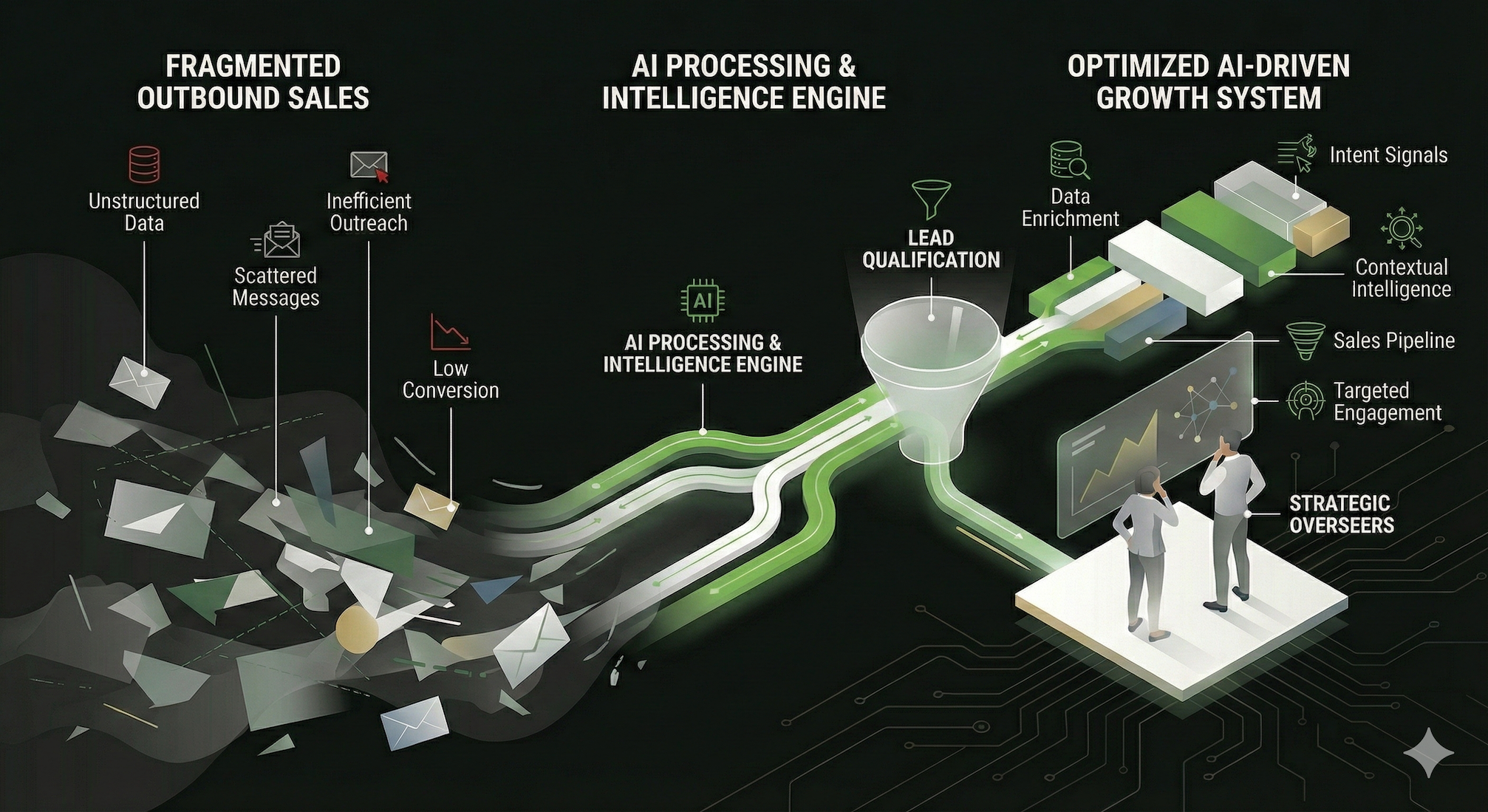
For years, B2B pipeline creation followed a predictable formula: hire SDRs, build lists, run sequences, and measure success by activity volume. That model scaled for a long time not because it was elegant, but because buyers were reachable, inboxes were quieter, and persistence often worked.
That world no longer exists.
Today’s buyers are more informed, harder to reach, and far less tolerant of irrelevant outreach. At the same time, growth teams are under pressure to deliver predictable pipeline with fewer people, tighter budgets, and higher expectations around personalization. The result is a growing mismatch between how pipeline is built and how buyers actually buy.
AI-driven outbound isn’t just a new tool layered on top of old workflows. It represents a structural shift in how B2B companies identify demand, engage prospects, and scale revenue, one that is quietly replacing SDR-heavy models across modern growth teams.
The traditional SDR model was designed for scale through human effort. Its success depended on activity volume: more calls, more emails, more follow-ups. In an era of limited digital noise, this worked well enough.
But buyers have changed faster than sales orgs.
Today, prospects are already researching solutions, comparing vendors, and forming opinions before responding to outreach. Cold calls feel interruptive rather than helpful, and generic emails are instantly filtered either by software or by the human brain. The gap between effort and outcome has widened.
At the same time, SDR economics have become harder to justify. Hiring, onboarding, and ramping reps is expensive and slow. Attrition is high, performance variance is wide, and productivity is difficult to standardize. When pipeline falls short, the instinctive response is often to add more SDRs multiplying cost without fixing the underlying inefficiency.
Tool sprawl has only made things worse. SDRs are expected to juggle CRMs, enrichment tools, engagement platforms, and intent data while maintaining speed and personalization. Context is lost, insights go unused, and execution becomes fragmented.
What was once a growth engine now feels like a fragile, high-maintenance machine.
AI-driven outbound flips the model from labor-driven scale to intelligence-driven scale.
Instead of working from static lead lists, AI systems continuously analyze signals company activity, hiring trends, content engagement, competitive movement, and behavioral intent—to determine who is most likely to engage at a given moment. Outreach becomes dynamic and timing-aware rather than scheduled and repetitive.
Instead of relying on rigid templates, AI can generate messages grounded in real context: what the company does, what has changed recently, and why the outreach is relevant now. This level of personalization is not cosmetic it fundamentally alters how the message is perceived by the buyer.
AI also introduces continuous experimentation into outbound. Messaging, tone, sequencing, and timing can be tested automatically at scale, with learnings fed back into the system in real time. Performance compounds not because people work harder, but because the system gets smarter.
Perhaps most importantly, AI makes outbound always-on. It doesn’t need ramp time, doesn’t burn out, and doesn’t forget follow-ups. Execution becomes consistent, adaptive, and responsive to market signals rather than dependent on individual capacity.
Outbound stops being a manual grind and starts behaving like a system.
Despite its power, AI does not eliminate the need for humans it reshapes where human effort creates the most value.
Strategic decisions still require human judgment. AI can identify patterns, but it cannot define your ideal customer profile, refine your positioning, or decide which markets are worth pursuing. Without clarity at the strategy level, AI simply accelerates misalignment.
Human involvement is also essential in complex, high-stakes conversations. Enterprise deals, multi-stakeholder buying committees, and nuanced negotiations still depend on trust, empathy, and situational awareness. AI can open doors and warm conversations, but humans close meaningful deals.
There is also the question of ethics, brand voice, and restraint. Automation without guardrails quickly turns into spam. Humans must define frequency limits, tone boundaries, compliance standards, and brand principles to ensure AI enhances reputation rather than erodes it.
Finally, AI produces insight but humans decide what to do next. Interpreting patterns, prioritizing experiments, and aligning outbound efforts with broader business goals remains a leadership responsibility.
AI amplifies human judgment; it does not replace it.
Adapting to AI-driven outbound requires more than adding another tool to the stack. It demands a rethink of roles, metrics, and operating models.
Teams should move away from large prospecting-heavy functions and toward smaller, more strategic revenue teams supported by intelligent systems. The future is not SDRs doing the same work faster it is fewer people doing higher-leverage work.
Data quality becomes a competitive advantage. AI performance depends on signal quality, feedback loops, and clean inputs. Teams that invest in meaningful data—not just more data—will see outsized returns.
Measurement must also evolve. Activity metrics like emails sent and calls made matter less than pipeline velocity, conversion quality, and revenue influence. AI makes experimentation cheap; teams should use that advantage to optimize outcomes, not vanity statistics.
Most importantly, outbound should be treated as a system, not a campaign. AI-driven outbound works best when it is continuous, adaptive, and tightly integrated with how the business learns and grows. Teams that think in systems will outperform teams that think in bursts.
AI is not eliminating outbound it is eliminating inefficient outbound.
The SDR-heavy model was built for a time when scale required people. AI-driven outbound is built for a time when scale requires intelligence. Companies that adapt will generate pipeline more predictably, lower their cost of acquisition, and engage buyers with relevance rather than noise.
The future of B2B pipeline is not human versus AI. It is human judgment, amplified by AI execution and the teams that understand this shift will define the next era of go-to-market growth.